Ohio Deflection Association
Post-Overdose Response
Community-Based
Self-Referral . Active Outreach
Intervention . Prevention
Call for Proposals is open · 2027 ODA Summit · due October 31, 2026
Submit a proposal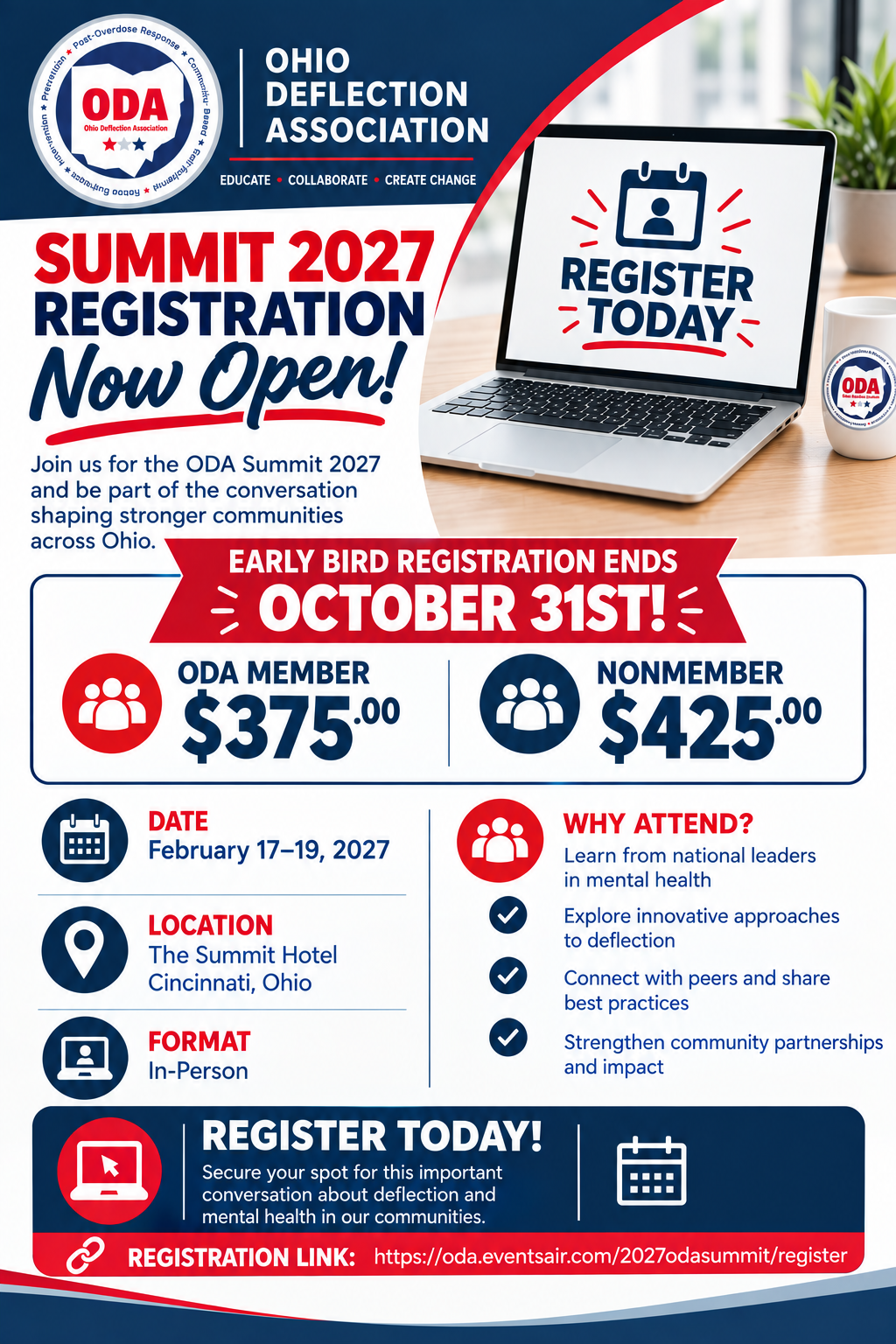
Now open · 2027 ODA Summit
Summit 2027 Registration
Join us for the ODA Summit 2027 and be part of the conversation shaping stronger communities across Ohio.
- Date
- February 17–19, 2027
- Location
- The Summit Hotel, Cincinnati, Ohio
- Format
- In-Person
Why attend?
- Learn from national leaders in mental health
- Explore innovative approaches to deflection
- Connect with peers and share best practices
- Strengthen community partnerships and impact
Secure your spot for this important conversation about deflection and mental health in our communities.
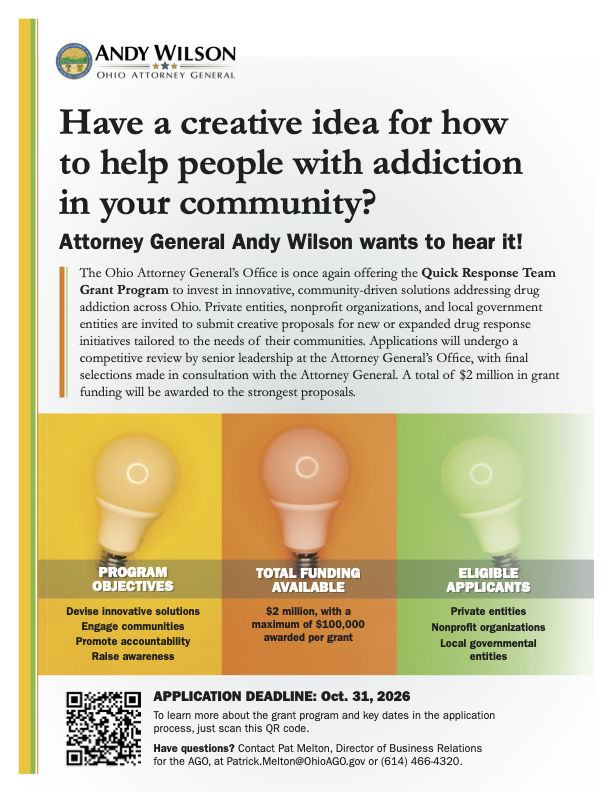
Funding opportunity · Ohio Attorney General’s Office
Quick Response Team Grant Program
The Ohio Attorney General’s Office is once again offering the Quick Response Team Grant Program to invest in innovative, community-driven solutions addressing drug addiction across Ohio. Private entities, nonprofit organizations, and local government entities are invited to submit creative proposals for new or expanded drug response initiatives tailored to the needs of their communities. Applications will undergo a competitive review by senior leadership at the Attorney General’s Office, with final selections made in consultation with the Attorney General. A total of $2 million in grant funding will be awarded to the strongest proposals.
- Eligible
- Private entities, nonprofit organizations, local governmental entities
- Winners selected
- Dec. 1, 2026
- Grant period
- January 2027 – December 2027
- Submit to
- QRTGrants@OhioAGO.gov (PDF or Word)
Program objectives
- Support innovative solutions: Fund creative, evidence-based, or promising approaches to combat drug addiction through response teams.
- Engage communities: Encourage collaboration among private entities, non-profits, and local governments to address addiction challenges.
- Promote accountability: Ensure funded projects deliver measurable outcomes that benefit individuals struggling with addiction.
- Raise awareness: Highlight successful initiatives through a public announcement event to inspire further action.
Have questions? Contact Pat Melton, Director of Business Relations for the AGO, at Patrick.Melton@OhioAGO.gov or (614) 466-4320.
What is deflection?
Out of systems. Into care.
Deflection is a collaborative intervention that connects public safety (police and fire/EMS) with health systems (public and behavioral health) to create community-based pathways to care for individuals experiencing substance use disorder, mental health disorders, or other unmet social determinants of health.
Our mission
Ohio Deflection Association delivers support around public safety for the health and wellbeing of those struggling with substance use and mental health disorder(s), through the development of deflection and pre-arrest diversion strategies, support tools, and facilitating the education of community partners providing outreach services. Focusing on real life challenges with real time solutions by providing communities with education, guidance, and resources.
2026 ODA Summit · watch on YouTube
Now open · 2027 ODA Summit
Summit Award Nominations
Do you know an individual, team, or organization that is making an exceptional impact in deflection and pre-arrest diversion across Ohio?
The Ohio Deflection Association (ODA) Summit Awards recognize those who demonstrate outstanding commitment to advancing deflection through:
- Innovative approaches
- Meaningful collaboration
- Positive community impact
- Dedication to improving outcomes for individuals and communities
If you know someone who is helping strengthen deflection efforts and create better pathways for individuals across Ohio, we want to hear about them!
Nominate a deserving individual, team, or organization today! Please provide specific examples that highlight the nominee’s contributions, accomplishments, and impact.
Let’s celebrate the people and organizations advancing deflection and making a difference in communities across Ohio!
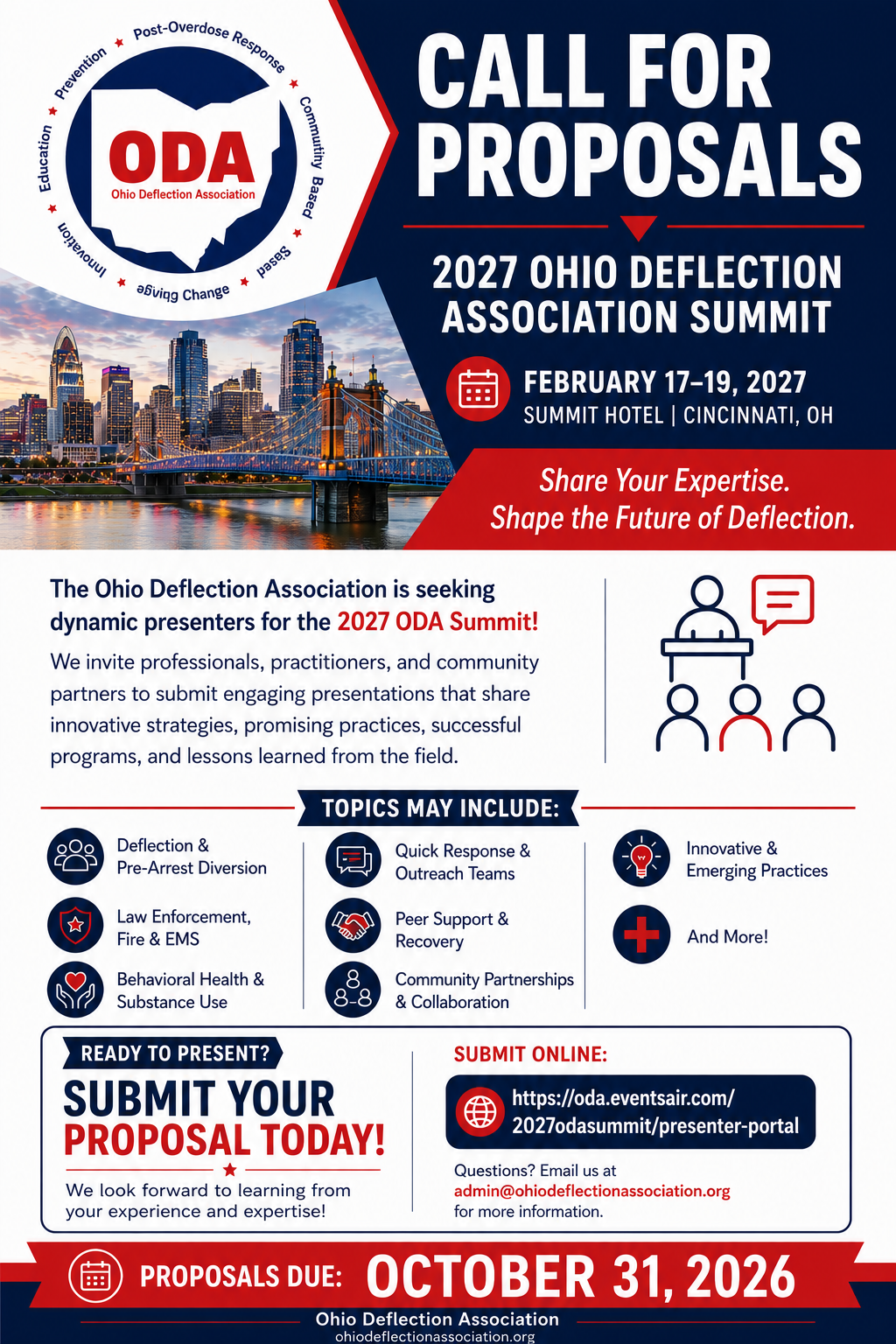
Now open · 2027 ODA Summit
Call for Proposals
- Summit
- February 17–19, 2027
- Location
- Summit Hotel, Cincinnati, OH
- Proposals due
- October 31, 2026
The Ohio Deflection Association is seeking dynamic presenters for the 2027 ODA Summit. We invite professionals, practitioners, and community partners to submit engaging presentations that share innovative strategies, promising practices, successful programs, and lessons learned from the field.
Topics may include
- Deflection and pre-arrest diversion
- Quick response and outreach teams
- Innovative and emerging practices
- Law enforcement, fire and EMS
- Peer support and recovery
- Behavioral health and substance use
- Community partnerships and collaboration
- And more
Questions? E-mail admin@ohiodeflectionassociation.org
News & announcements
Deflection news
-
Resource guide
Deflection Data Collection and Definitions Guide
Read more about the Definitions Guide
The Ohio Deflection Association, in partnership with the Criminal Justice Coordinating Center of Excellence's Substance Use Deflection Initiative, is proud to announce the Deflection Data Collection and Definitions GuidePDF. The guide helps diverse deflection teams across Ohio operate under the same standardized definitions, ensuring accurate statewide data collection and strengthening the measurement of outcomes.
“Aligning terminology across diverse teams strengthens our collective ability to measure impact and ensure Ohio's deflection efforts continue to grow in clarity, consistency, and effectiveness.”
— Ashley Morgan, Director, Substance Use Deflection Initiative“This marks the first step in a meaningful partnership with the Substance Use Deflection Initiative. Together, we will formalize best practices and drive innovation in the emerging field of deflection across Ohio, always keeping the best interests of the citizens we serve at the forefront.”
— Tom Fallon, Executive Director, Ohio Deflection Association -
Survey
Voices from the Field survey
Read more about the survey
The survey takes just a few minutes and covers the topics, presenters, and practical resources that would most help your team in the year ahead. Responses are reviewed by the Summit planning workgroup.
-
In the news
First-of-its-kind panel reopens overdose death cold cases
Read more about the cold case panel
The panel brings together law enforcement, coroners, and public health partners to revisit unsolved overdose deaths, identify sources of supply, and give families answers that were previously out of reach. It is believed to be the first review body of its kind in the country.
-
Policy
Governor DeWine authorizes emergency rule on overdose-prevention tools
Read more about the emergency rule
Ohio Governor Mike DeWine signed Executive Order 2025-04D to suspend the normal rulemaking process, allowing the Ohio Board of Pharmacy to adopt a rule expanding access to overdose-prevention tools. In addition to test strips and reagent kits for fentanyl, rule OAC 4729-8-02 exempts tests for the following compounds from Ohio's definition of drug paraphernalia:
- Xylazine
- Medetomidine
- Benzimidazole-opioids (commonly referred to as nitazenes)
- Benzodiazepine and benzodiazepine-related compounds
-
Funding
SOS 4.0 NOFO is open in Ohio
Read more about the SOS 4.0 funding opportunity
Selected applicants will provide evidence-based practices across the care continuum — prevention, opioid overdose reversal medication (OORM), treatment, and recovery support — aimed at opioid use disorder, stimulant use disorder, and concurrent substance use disorders, aligned with Ohio's SOS 4.0 goals and intended outcomes.
Planned investment areas
- Treatment: FDA-approved MOUD in Opioid Treatment Programs (OTPs), low-barrier settings, and criminal justice settings, plus other evidence-based practices.
- Community and family resiliency: evidence-based prevention reaching children, youth, young adults, older adults, families, and their communities.
- Recovery supports: recovery housing, peer support, and supported employment.
Eligibility: DBH seeks applications from qualified Ohio ADAMH boards and non-profit and for-profit community organizations meeting the statutory requirements for licensed and/or certified community behavioral health services providers, private psychiatric hospitals, and residential Class 1, 2, and 3 facilities enacted through House Bill 33.
Follow along